COIL Micromachining System
A four-axis femtosecond-laser fabrication platform developed to position optical fibre and transparent samples with the precision, visibility, and automation required for direct-write photonics.
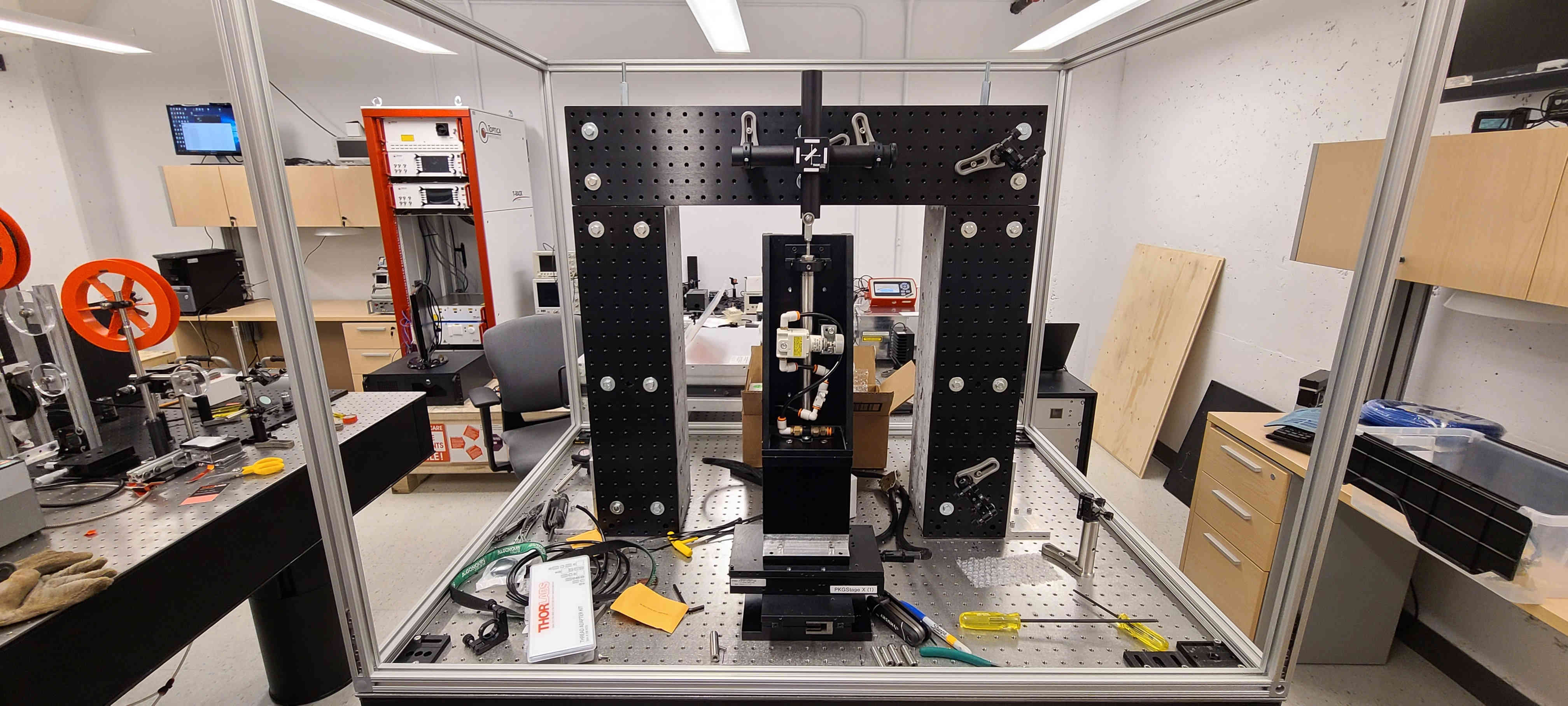
The instrument behind the fabricated device.
Direct-write photonics requires more than a focused laser. The sample must be aligned, observed, and moved through the focal volume with consistent velocity and nanometre-scale command resolution while laser exposure remains synchronized with the trajectory.
The COIL system was designed and assembled as an integrated research platform rather than a single-purpose machine. Its four controlled axes support fibre translation and rotation, bulk-sample processing, line scanning, point placement, and new geometries that can be introduced through software.
Motion, imaging, optics, and control as one platform.
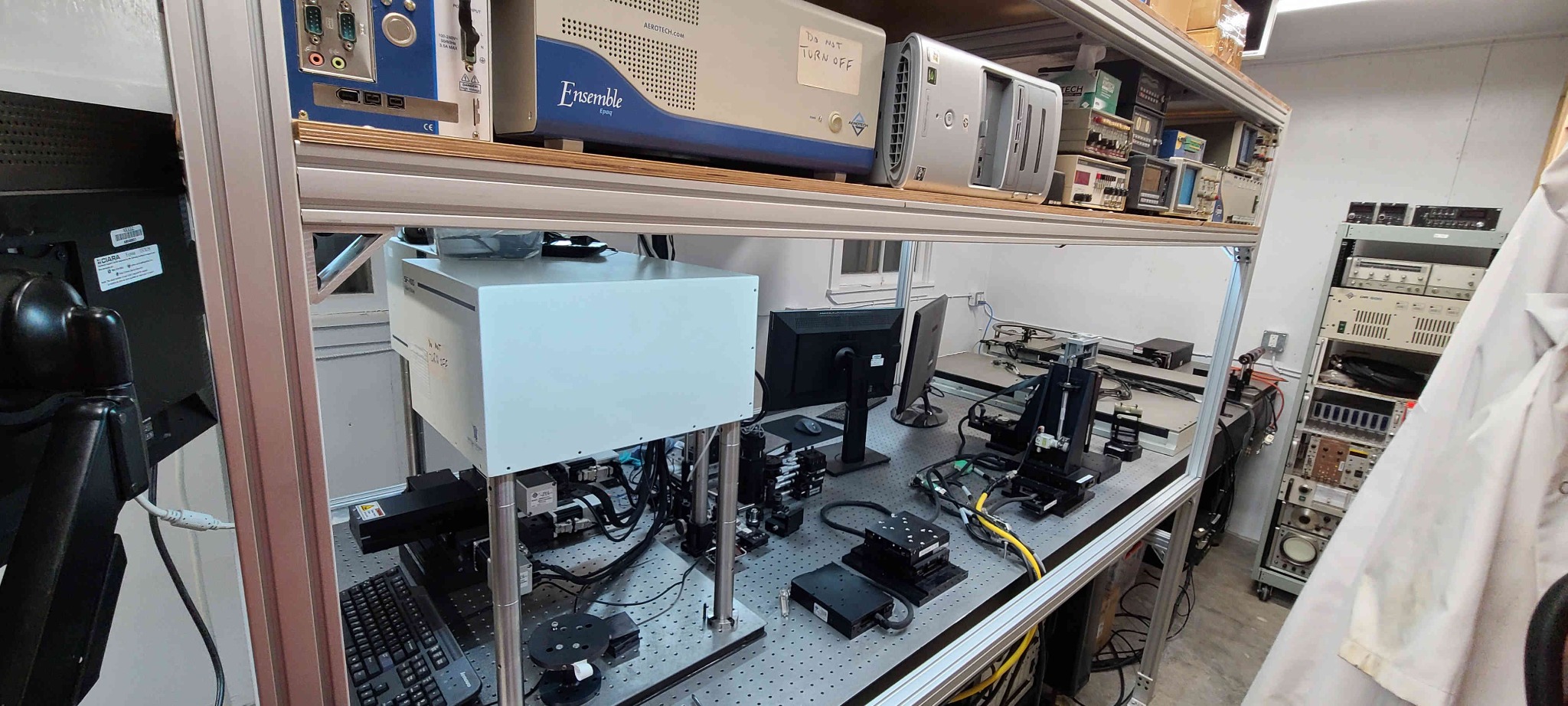
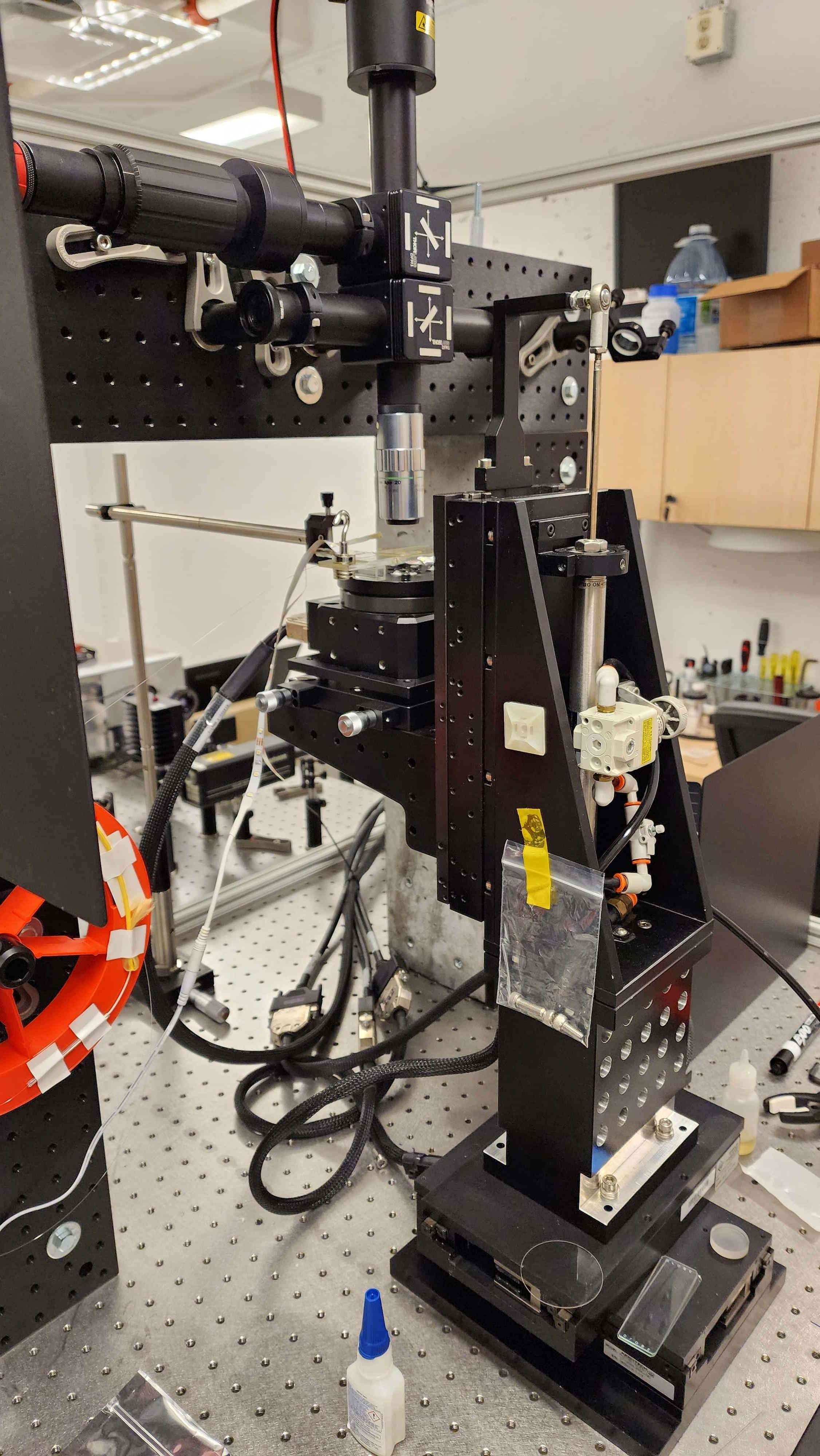
The system combines high-resolution linear and rotary stages with a vertical microscope, coaxial and transverse viewing, fibre-handling hardware, laser-delivery optics, and a rigid frame built around an optical table. An enclosed work volume improves laser safety and reduces unwanted environmental disturbance.
- XYZ translation and U-axis rotation for fibre and bulk-sample positioning.
- Infinity-corrected microscope imaging for focus, alignment, and process observation.
- AeroBasic motion programs for coordinated trajectories, velocity control, settling, and digital-output laser gating.
- Software-assisted fibre-core localization and real-time image analysis.
- Modular sample fixtures and optical layouts for changing research requirements.
Trajectory is part of the optical design.
For grating inscription, stage velocity and laser repetition rate determine the longitudinal modification spacing. Position error, acceleration, scan direction, trigger delay, and segmentation can therefore appear directly in the fabricated structure and its spectrum.
The controller programs manage lead-in and lead-out motion, synchronized exposure, coordinated axes, point placement, and safety interlocks. This turns motion programming into an experimental parameter and allows fabrication strategies to be expressed as repeatable recipes.
One machine, multiple inscription regimes.
The platform has supported line-by-line and point-by-point FBG inscription, process-development arrays, fused-silica machining, refractive-index modification, and the early development of nonlinear optical structures.
Its design and experimental validation formed the central engineering contribution of the 2024 master’s thesis and continues to provide the mechanical and software foundation for doctoral research.