Coherent Libra Restoration
The acquisition and subsystem-level restoration of a used high-energy Ti:sapphire regenerative amplifier for an independent ultrafast photonics laboratory.
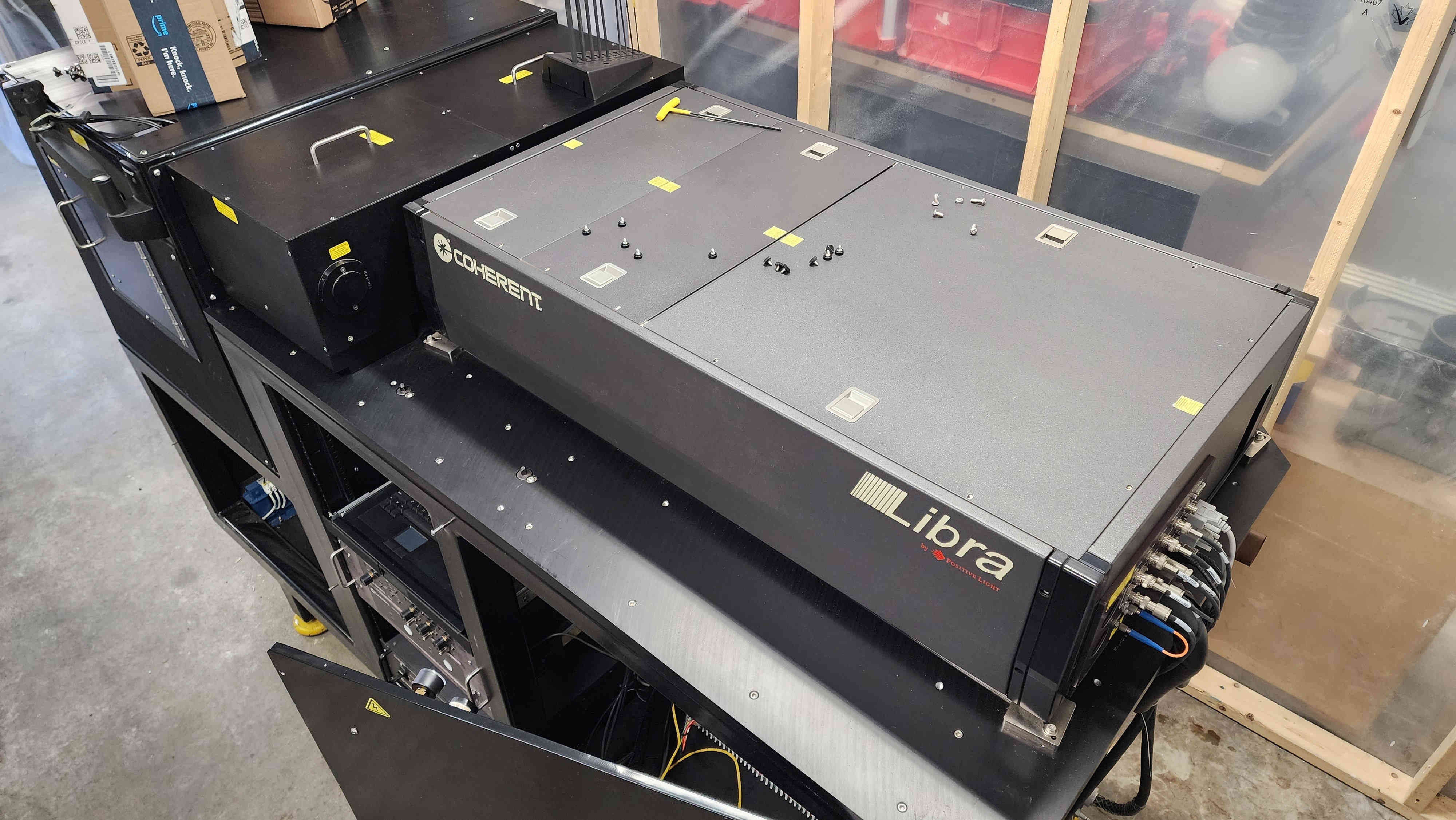
Recovering a complex ultrafast system.
The Coherent Libra is a chirped-pulse Ti:sapphire regenerative amplifier designed to produce energetic femtosecond pulses. The system was acquired used with a non-operational seed-laser subsystem, making diagnosis and restoration a prerequisite to any experimental use.
Unlike a single optical assembly, a regenerative amplifier depends on a chain of coupled subsystems: seed generation, pump lasers, pulse stretching, cavity injection, amplification, extraction, compression, cooling, control electronics, and safety interlocks.
Diagnose before alignment.
The repair strategy separates electrical, thermal, control, and optical faults so that each stage can be tested without introducing unnecessary alignment changes. Historical documentation, service information, signal tracing, and subsystem testing are essential because an apparent optical failure can originate in power, timing, cooling, or control electronics.
- Document the system state, cabling, utilities, interlocks, and known fault history.
- Verify power supplies, cooling loops, pumps, control communication, and safety systems.
- Establish seed-laser operation and characterize power, spectrum, pulse train, and spatial mode.
- Check pump delivery and regenerative-cavity timing before disturbing critical alignment.
- Commission amplification and compression progressively while monitoring stability and beam quality.
Interdependent faults and incomplete information.
Legacy research lasers are rarely accompanied by a complete service history. Replacement modules may be unavailable, proprietary interfaces may be poorly documented, and alignment procedures often assume access to factory fixtures or diagnostic tools.
The restoration therefore requires a conservative approach: preserve known-good alignment, make measurements before adjustments, create reversible interfaces, and validate each subsystem independently. The project is as much about reconstructing system knowledge as replacing failed components.
A high-energy source for independent experiments.
Once commissioned and characterized, the system expands the laboratory’s accessible pulse-energy range and supports material processing, nonlinear optics, laser-induced plasma studies, optical-component testing, and the development of experimental hardware around high-energy femtosecond pulses.
The project also creates reusable technical knowledge in ultrafast-laser diagnostics, precision optical alignment, power electronics, cooling, timing, and safe laboratory integration.