Fibre Bragg Grating Inscription
Direct femtosecond-laser fabrication of wavelength-selective structures in optical fibre, with control extending from the motion of the inscription platform to the spectrum of the finished device.
Writing periodic structure directly into the fibre core.
A fibre Bragg grating is a periodic refractive-index modulation that reflects a narrow spectral band while transmitting other wavelengths. The device is compact and inherently compatible with fibre systems, making it useful for sensing, filtering, telecommunications, and laser cavities.
This project studies gratings written with focused ultrashort pulses rather than a conventional ultraviolet phase-mask process. The laser-induced modification can be placed plane by plane, providing direct control over grating pitch, length, order, transverse geometry, and local coupling.
How does the written structure determine the optical response?
Direct writing makes the grating a sequence of individually addressable modifications. That flexibility introduces new design freedom, but it also couples device performance to focus quality, fibre alignment, modification morphology, motion accuracy, pulse delivery, and the overlap between the written region and the guided mode.
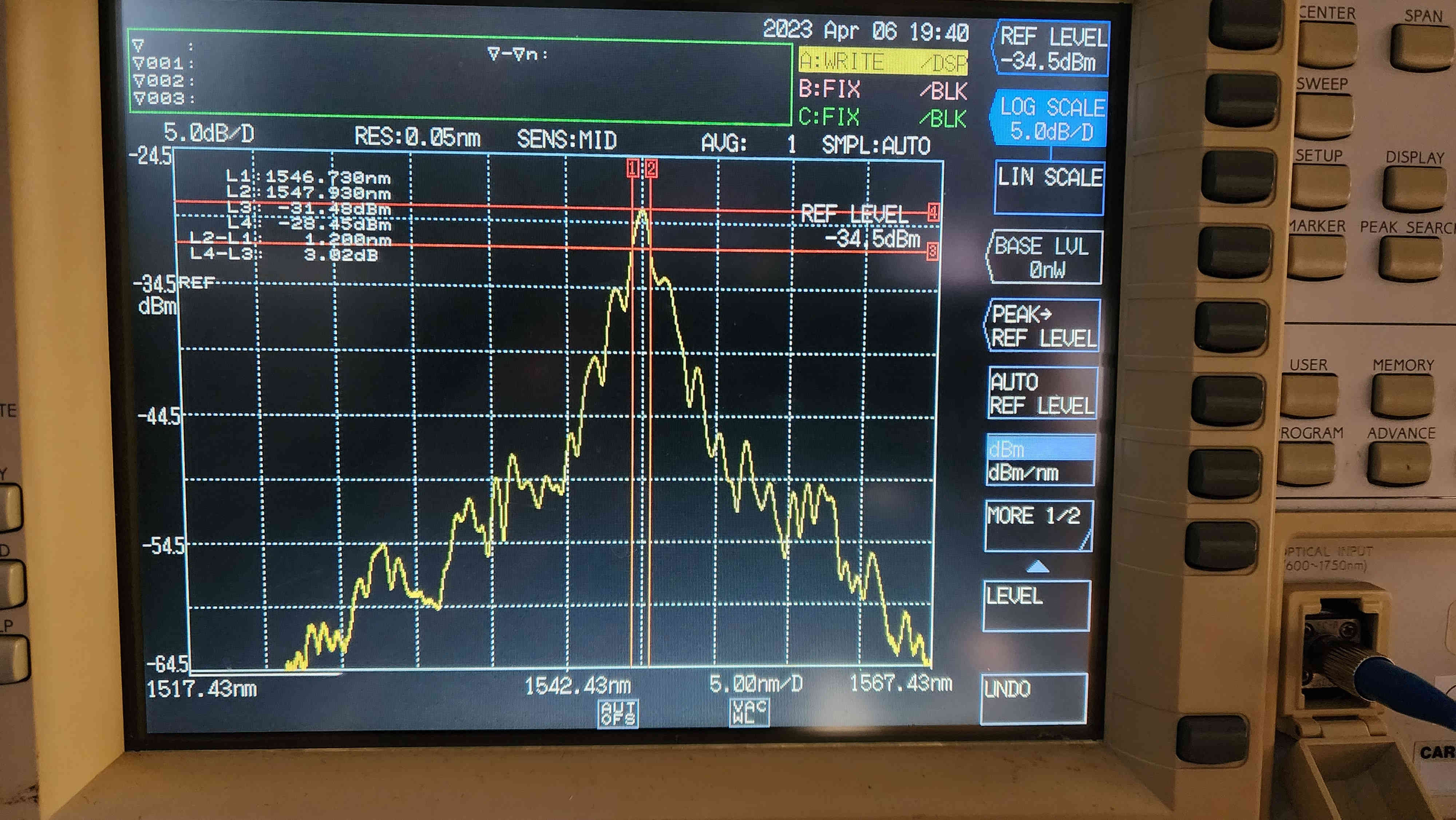
The research therefore treats fabrication and spectroscopy as a closed loop: structures are designed, written, measured in reflection and transmission, and then examined to identify which process variables control resonance strength, bandwidth, insertion loss, cladding-mode excitation, birefringence, and thermal stability.
- Compare point-by-point, line-by-line, and plane-based inscription geometries.
- Control coupling through modification size, transverse position, scan strategy, and laser repetition rate.
- Separate useful refractive-index change from scattering damage and off-resonance loss.
- Develop apodized, chirped, phase-shifted, sampled, and deliberately randomized grating structures.
Low loss with extreme-temperature stability.
The Type-X work investigates line-by-line FBGs that exhibit Type-I-like optical quality and Type-II-like thermal stability. By controlling scan count, pulse energy, and grating order, the inscription can remain below the onset of microscopic scattering damage while producing a modification that survives temperatures above 1000 °C.
The 2025 Optics Express study showed that overwriting the same grating plane increases damage and cladding-mode loss, while single-scan planes written at higher grating orders provide a favourable low-loss, high-stability regime.
Engineering the grating one plane at a time.
Current work extends the same fabrication control toward visible-wavelength gratings, nonlinear optical structures, engineered coupling profiles, randomized plane sequences, multi-resonance devices, and fibre-integrated structures for frequency conversion and quantum photonics.
The long-term objective is a general inscription framework in which the local coupling and phase of each plane can be programmed, simulated, and fabricated with sufficient repeatability that complex spectral responses become a design variable rather than a fabrication accident.